Before You Buy a Freestanding Soaking Tub: Two Things Every Homeowner Must Know
You found the tub. It looks perfect in the photo. You’re already imagining where it goes.
Stop for two minutes.
There are two mistakes we see homeowners make on nearly every freestanding tub installation — mistakes that don’t show up until after the tile is set, the inspector has visited, or the subfloor has quietly soaked through. Both are easy to avoid. Neither one is obvious until someone who’s seen it happen tells you to watch out.
This is that conversation.
Mistake #1: Buying a Cheap Tub Filler Online
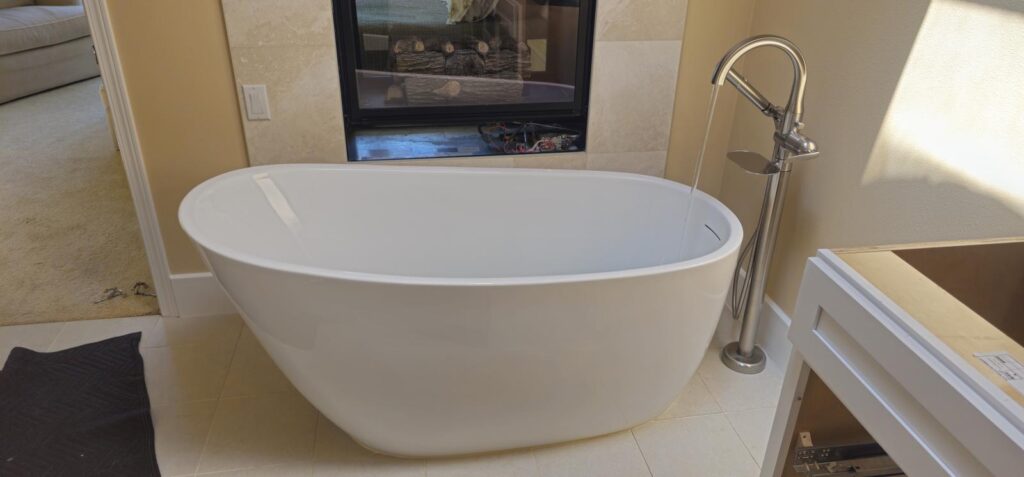
A freestanding tub needs a freestanding tub filler — a floor-mounted faucet that rises up to meet the tub. It’s a centerpiece fixture. It should look like it belongs.
The problem? Amazon is flooded with low-cost tub fillers that look impressive in product photos and fall apart in real life. The most common failure point isn’t the finish, the handles, or even the valve cartridge.
It’s the base.
These budget fillers use thin, lightweight bases that are not engineered to bear the leverage created by a tall floor-mount faucet. Once installed, they wobble. Not dramatically at first — just a slight give when you touch the spout. But every time someone grabs the filler to steady themselves getting into the tub, that wobble stresses the connection at the floor. Over months, the seal weakens. Water works its way in. Subfloor damage follows.
What should a proper tub filler base look like? Heavy. Solid brass or substantial metal construction. It should feel like it’s part of the floor, not sitting on top of it. When you pull on the spout with reasonable force, nothing should move.
What to look for instead:
- Solid brass body construction (not zinc alloy or pot metal)
- Floor plate that is wide and flat, with multiple anchor points
- A warranty from a brand that has a U.S.-based customer service line you can actually reach
- Reviews that mention long-term use — not just “looks great on arrival”
The price difference between a budget filler and a quality one can feel significant in the moment. It is far less significant than replacing water-damaged subfloor and tile.
Mistake #2: Skipping the Thermostatic Mixing Valve
This one isn’t just about product quality. It’s about code compliance and, more importantly, safety.
Most water heaters are set between 120°F and 140°F. At the higher end of that range, the temperature is intentional — it suppresses bacteria growth (specifically Legionella) inside the tank. But water at 140°F reaching your bathtub faucet is genuinely dangerous. It can cause serious scalding in seconds, particularly for children and older adults whose skin is more sensitive.
This is why most jurisdictions require a thermostatic mixing valve (TMV) on soaking tubs and bathtub fill lines. The valve blends hot water from the heater with cold water to deliver a consistent, safe temperature to the fixture — typically set at 120°F maximum, which is the standard threshold in most building codes.
Here’s what that means practically:
- Your water heater stays set high enough to kill bacteria and supply the whole house
- Your tub filler receives pre-mixed water that cannot exceed the set temperature, no matter how the handles are turned
- You are protected from sudden temperature spikes if someone elsewhere in the house flushes a toilet or runs cold water
A thermostatic mixing valve is not a luxury add-on. In many states and municipalities, it is a code requirement for bathtub installations. Your plumbing inspector will look for it. If it’s missing, you will not pass inspection — and more importantly, your family will be using a fixture that poses a burn risk every time someone fills the tub.
What installation looks like:
The mixing valve is installed in the supply line feeding the tub filler. Depending on your bathroom layout, it can be located at the water heater itself or behind an access panel in the wall near the tub — both approaches give a plumber the ability to service or adjust the valve without tearing into finished surfaces. It is separate from the decorative faucet handles. A licensed plumber installs and calibrates it, measuring output temperature with a thermometer to confirm the 120°F limit before the access panel closes. It is not something to skip to save a few hundred dollars on labor.
Brands Worth Trusting
Once you’ve decided to invest in a quality tub filler, the next question is which brand to trust. These three have earned their reputations through consistent build quality, parts availability, and warranties that actually mean something.
Moen is the easiest recommendation for most homeowners. Their freestanding tub fillers use solid brass construction throughout, and their LifeShine finish is backed by a lifetime warranty against tarnishing, flaking, and corrosion. Moen also has one of the most accessible customer service operations in the industry — if something goes wrong years down the road, you can actually get help. For a mid-range budget that doesn’t compromise on durability, Moen is where most people should start.
Delta brings strong engineering credentials and excellent valve technology. Their freestanding fillers are built to last, and Delta’s widespread parts availability means a plumber can service the fixture almost anywhere without ordering specialty components. If you’re drawn to a more contemporary or transitional aesthetic, Delta’s freestanding line offers strong options at a competitive price point.
Kohler is the premium choice. Their freestanding tub fillers are heavier, more refined, and available in a broader range of finishes — including some exclusive options you won’t find elsewhere. The base construction on Kohler floor-mount fillers is notably solid. If you’re investing in a high-end bathroom and want the fixture to match that level, Kohler delivers. Expect to pay more, and expect it to be worth it.
For homeowners who want to step further into the luxury tier, Brizo (Delta’s designer line) is worth a look — particularly if design precision and a fashion-forward aesthetic appeal to you. Brizo carries a higher price tag but backs it up with exceptional fit, finish, and longevity.
One rule applies across all of them: buy from an authorized dealer or a reputable plumbing supply house, not a third-party marketplace listing. Counterfeit fixtures and gray-market products are a real problem, and manufacturer warranties are only honored on authorized purchases.