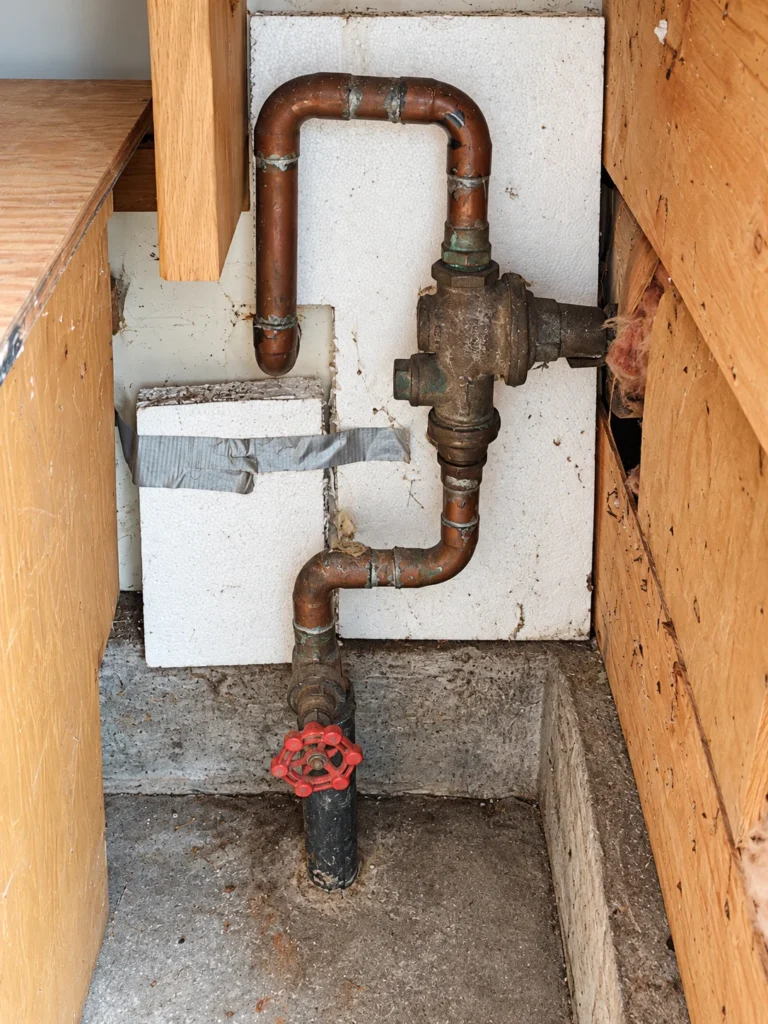
A leaking main water shutoff valve is a problem we have been seeing on service calls. Often it is an old gate-style valve, and the homeowner wants a dependable quarter-turn replacement. On many of these jobs, the pressure-reducing valve (PRV) is also 20–30 years old, so we discuss whether replacing it during the same work makes sense.
The leaking shutoff and the PRV are separate parts with separate jobs. A new shutoff addresses a leak at that valve and gives you a reliable way to turn off the house water. The PRV controls pressure on the house side. We check static pressure and the condition and age of both valves before recommending the scope of work.
What causes a leaking main water shutoff valve?
Water may be escaping around the valve stem, the valve body, or a nearby pipe connection. A small drip can also travel along a pipe and make the source hard to spot. An older gate valve may not close completely when you need it, so we check both the leak and its ability to shut off water.
When replacement makes sense, a quarter-turn ball valve is often a practical upgrade. The exact repair depends on the valve location, available access, pipe material, and how the water can be safely isolated.
Older CPVC needs extra care. CPVC can become brittle as it ages. If a main valve on CPVC is 20 years old or older and its handle is stuck, I do not recommend trying to turn it; the force can crack the pipe or connection. For a replacement, we can remove a short section of CPVC and, where the existing pipe is sound, use a suitable push-to-connect fitting to transition to a short PEX or copper connection for the new valve. We confirm the material, pipe condition, and repair method on site.
Why we check the PRV during the same visit
A PRV reduces incoming water pressure for the plumbing downstream of it. If it no longer regulates properly, a static pressure reading at a hose bib on the house side may be higher than expected. Dripping fixtures and unusually strong flow can be clues, but neither proves the PRV has failed. For background, see Watts’ explanation of pressure-reducing valves.
We use a pressure gauge on a hose bib to take a static pressure reading while no water is running. That number helps us evaluate household pressure at the time of the visit. A single reading or a dripping valve alone does not tell us why pressure is high, so we check the valve location and the rest of the assembly before recommending PRV work.
4 essential checks for a leaking main water shutoff valve
1. Locate the drip. We identify whether water is coming from the old shutoff, a nearby connection, or another part of the assembly.
2. Check the shutoff. We assess whether the gate valve can reliably stop water and what is needed to replace it with a quarter-turn valve.
3. Measure static pressure. We connect a gauge to an accessible hose bib and record the reading with no water running. We confirm whether that hose bib is downstream of the PRV before using the number to judge regulated house pressure.
4. Explain the options. We separate the leak repair from any pressure-control work so you can see what each recommendation addresses.
Should the main shutoff and PRV be replaced together?
I usually recommend replacing the PRV when we replace an old main gate shutoff, especially when both have been in service for about 20–30 years. At that age, the PRV may be nearing the end of its useful life, and doing both while the water is already shut off can be practical. We can review your photos, explain what each replacement addresses, and give a bid for the work. A newer PRV in good condition may not need replacement.
What to send us before the visit
Please send clear photos of the main shutoff, the PRV if you can see it, and the nearby piping. Tell us where the drip appears and whether the shutoff still turns. We use those photos to prepare a bid. Avoid forcing a stiff old gate valve, especially when it is connected to older CPVC. If water is actively leaking, arrange plumbing help promptly and protect nearby belongings.
You can check static pressure yourself: Buy a hose bibb water pressure gauge at a hardware store or online, attach it to an outdoor hose bibb, make sure no fixtures or appliances are using water, open the hose bibb fully, and note the reading. Send us a photo of the gauge. If that hose bibb is on the house side of the PRV, a static reading below 80 PSI is in the green zone. Some hose bibbs connect before the PRV, so we will confirm what your reading represents before drawing a conclusion.
What will the repair cost?
How much does a 1-inch main shutoff valve replacement cost?
For a 1-inch main shutoff valve replacement, our starting range is about $400–$800. The final price depends on access, the condition of the nearby piping, and how the water can be isolated. We confirm the scope and quote before work begins. A PRV replacement, if needed, is quoted separately.
If the PRV also needs replacement, is that a separate cost?
Yes. Replacing the old gate shutoff with a quarter-turn valve and replacing the PRV are separate parts of the work. When the PRV is roughly 20–30 years old, I usually recommend replacing it during the main shutoff job because it may be nearing the end of its useful life. We check static pressure and the condition of the assembly, then explain the scope and price for each part before work begins. Access, piping condition, valve size, and water isolation can affect the total.
Have a dripping main shutoff?
5 Corners Plumbing can review photos of the old gate valve and nearby piping, discuss a quarter-turn replacement, and recommend whether to replace the PRV at the same time. Send clear photos and a short description through our contact form so we can give you a bid from the pictures.
Request an inspectionLearn more about PRV installation and water pressure.